• Skip to primary navigation
  • Skip to main content
  • Skip to primary sidebar

Meet Ashwin

Helping Engineers To Become Tech Leaders

  • Blog
  • Newsletter
  • Courses
    • Generative AI 101
    • LLMOps 101
    • Data Platforms Made Easy
  • Products
    • Generative AI Ecosystem Mindmap
    • 8 Mistakes to avoid in Tech Leadership (e-book)
  • Resources
  • Contact

Ashwin

A Framework to Acing Your Next Tech Presentation

April 10, 2024 by Ashwin Leave a Comment

A tech presentation is daunting, especially when the stakes are high, such as presenting to senior leadership or prospective clients.

But a presentation is also an excellent opportunity to deliver your message. A group of attentive people, listening to every word you speak. It doesn’t get better than this.

So how can you ace it? Here’s a framework you can use for your next big presentation.


#1 Start the presentation with “what’s in it for them”

In a presentation, everyone invests their most valuable asset—their time.

Start by addressing what’s in it for them and what they’ll gain in return for their time.

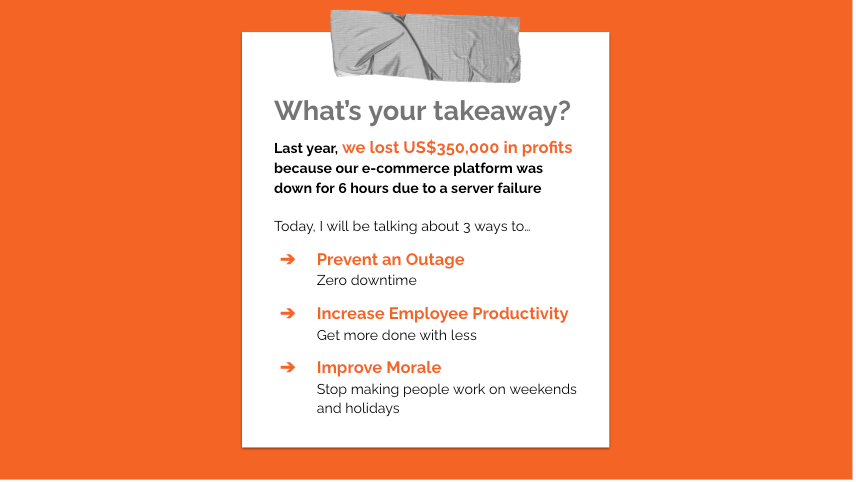
Here’s an example intro slide.

Presentation slide to explain what's in it for the listeners
A slide for what’s in it for the listeners

In the above intro slide we:

  • Give them a reason to care (preventing financial loss)
  • Establish relatability (reference to a past outage)
  • Instill a sense of responsibility (towards their employees)

#2 Explain the purpose behind your presentation

Now transition to your “whys” after establishing what your audience can take away.

  • Why are you presenting it now? (because a major e-commerce event is coming up soon…)
  • What changed from last time? (you have better tools, technology, people now…)
  • Why should they care? (employee happiness score was low due to such recurring outages…)

Highlight your competitors’ strategies at this point.

Having established the reasons why your audience should listen to you now, let’s proceed to actions.

#3 What’s your CTA (call to action)

Once your audience understands the message, clearly articulate what actions you need them to take.

Are you asking for budget approval?

Are you asking for their time commitment?

Are you asking for a new team?

Be very clear about your ask.

This is where most of us fall short. Don’t make that mistake.

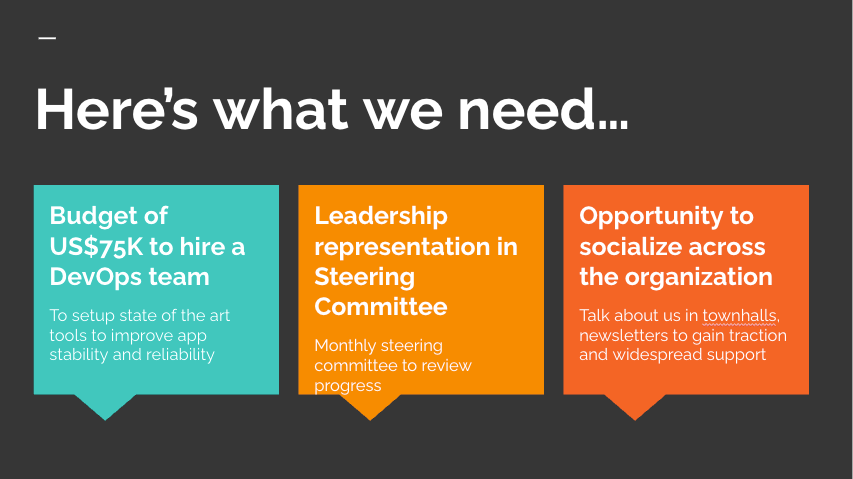
Here’s an example call to action slide.

A sample CTA slide
A sample CTA slide

#4 What does the listener (or the team/organization) miss if your CTA is not done

Remind the audience of what the organization stands to lose if the necessary actions are not taken.

By now they should have the message.

But it is essential to reiterate so that the point is delivered.

Here are some examples:

There will be a missed opportunity to save costs and improve margins.

Customer experience will take a hit.

Our brand will suffer a bad PR.

Be very specific and make it impactful.

#5 How does the roadmap for CTA look like…

End your presentation with a plan of action.

Everyone wants to see a plan.

The plan gives confidence that you can walk the talk.

Make it very simple and call out only key milestones.

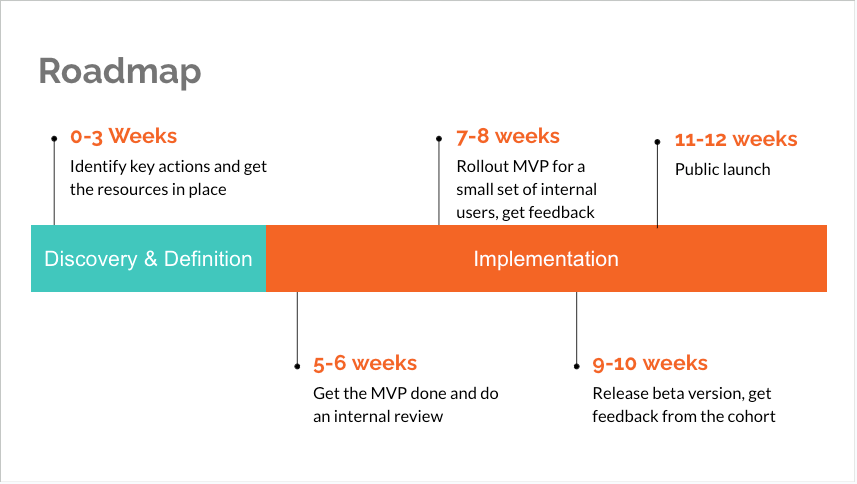
Here’s an example roadmap.

A presentation slide for a sample CTA roadmap
A sample CTA Roadmpa

That’s it! You now have a compelling framework to apply in your next big presentation.

To recap:

  • Start with “what’s in it for them”
  • Explain the purpose behind your presentation
  • What’s your CTA (call to action)
  • What does the listener (or the team/organization) miss if your CTA is not done
  • How does the roadmap for CTA look like

All the best! You’ll rock it…

In case you haven’t read, Presentation Zen is an amazing book for every presenter our there. Do yourself a favour and grab a copy!

Filed Under: Presentations, Tech Tagged With: communication, leadership, presentations, tech

Understanding the Paradigm of AI Tools, Apps and Agents

April 9, 2024 by Ashwin Leave a Comment

If you’ve been following the advancements in the AI (Artificial Intelligence) space, it will be no surprise to you that tons of models and apps are released every single day.

AI solutions come in various forms and solve a wide range of use cases. Though the evolution is still at its nascent stage, I see a few trends emerging.

In this post, I talk about three types or categories of AI solutions – AI tools, AI assistants, AI agents – why they exist and what problems they solve.


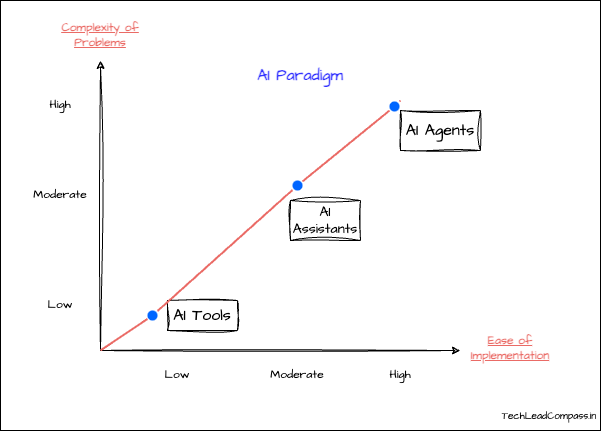
Here’s a comparison of the various types of AI solutions, their applicability, and ease of implementation.

AI Paradigm

Let’s start with the first one.

#1 AI Tools

This is something most of us are familiar with.

AI tools are software applications that using artificial intelligence and models, to perform specific tasks and solve problems.

ChatGPT, Copilot, and Perplexity are good examples of this.

What are their characteristics?

  • They offer a standard interface to interact (web app, mobile app, etc.)
  • They are useful for general-purpose use cases (e.g., summarizing an article, tightening a paragraph, understanding a specific topic, etc.)
  • With prompt engineering, they can understand your context and generate better content

They are good as a general-purpose vehicle, covering majority of an average person’s needs.

#2 AI Assistants

How do they differ from an AI tool? Not by a huge margin.

AI Assistants are a specific adaptation of AI tools that make it easier and simpler to use an application or a website

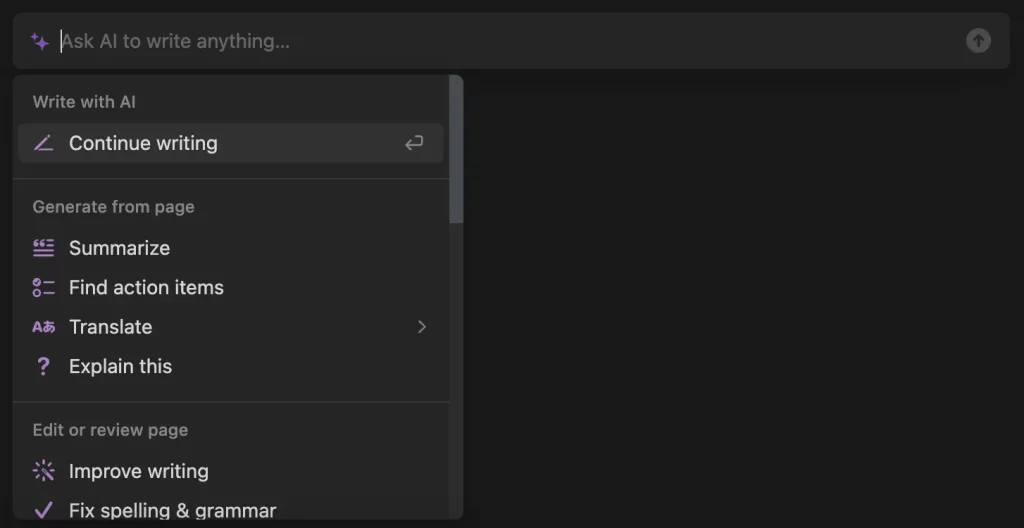
Have you seen the AI assistant in Notion, that helps you write? It is an AI assistant.

  • AI assistants are very context-specific and assist you with specific activities
  • They make use of one or more AI tools behind the scenes
  • With continuous usage, they can adapt and assist you better

#3 AI Agents

AI Agents take the game to the next level.

AI Agents are designed to perceive the environment, process signals, and take actions to achieve specific goals.

These agents can be software-based or physical entities and are commonly built using artificial intelligence techniques.

AI agents typically have 3 distinct components:

  • Sensors & Perception Layer – process signals and find out what’s happening in the environment
  • Skills Layer – to examine different options based on inputs
  • Decision Layer – to take actions and send it to the target environment

This space is still nascent. Auto-GPT, BabyAGI are some frameworks gaining traction.

There is consensus that most growth will be here – to automate workflows and perform actions that otherwise require complex decision-making.


To conclude…

AI Paradigm can be seen as a combination of general-purpose AI tools, specialized AI apps, and sophisticated AI agents. Each differs in its purpose, ease of use, and applicability. AI agents that mimic humans is where I anticipate huge growth in the future!

Filed Under: AI, Tech Tagged With: ai, genai, machine learning, ml, tech

How hands-on an Engineering Leader should be?

July 22, 2023 by Ashwin Leave a Comment

Engineering leader toolkit

Most of know and realise by this time that a hands-on engineering leader is respected and probably more successful in their career. But there are other key responsibilities for senior leaders, in addition to be technically active. In this post, I will share my thoughts on how hands-on an engineering leader should be and how to maintain a healthy balance with other duties.

What we mean by hands-on engineering leader?

By hands-on, we mean that an engineering leader, irrespective of his or her seniority, must be able to understand working details of products and applications they own.

Here are some example hands-on activities of a software engineering leader:

  • Participate and contribute to system architecture
  • Lead technical design and solution discussions
  • Understand technical and delivery metrics
  • Articulate with engineerings in technical language

But, do these alone justify the role of a leader?

Probably not. The true value of a senior engineering leader comes from another important contribution.

A senior leader must be a multiplier – enabling and empowering others to perform at their fullest potential.

If you haven’t read it yet, Multipliers by Liz Wiseman is an excellent book on this topic.

A leader must create a right environment and help everyone in the team play their “A” game. This is where their true value comes in.

Also in his iconic book High Output Management, Andy Grove talks about high leverage activities for managers and leaders.

A high leverage activity is something that sets an individual or team for success over an extended period of time.

Here are some high leverage activities for a software engineering leader:

  • Coaching, training and mentoring employees
  • Effective 1:1 meetings
  • Creating a culture of efficient meetings
  • Setting up right tools and platforms to increase engineering productivity
  • Using right metrics and creating feedback loops for better software delivery

In short, any activity that has a throughtput-to-effort ratio greater than 1:1 is a high leverage activity.

To be or not to be…

In essence, as you grow in your career as an engineering leader – try and maintain a good mix of hands-on and high leverage activities.

While being hands-on is essential to continue and wield your expert power, high leverage activities are the ones that can up your game to the next level.

Always remember – “What got you here, won’t get you there!” (Thanks Marshall Goldsmith!)

Filed Under: Leadership, Life Tagged With: engineering leader, high leverage activities, leadership, multipliers, successful leader

  • « Go to Previous Page
  • Page 1
  • Interim pages omitted …
  • Page 3
  • Page 4
  • Page 5
  • Page 6
  • Page 7
  • Interim pages omitted …
  • Page 12
  • Go to Next Page »

Primary Sidebar

Connect with me on

  • GitHub
  • LinkedIn
  • Twitter

Recent Posts

  • Enterprise AI Agents: Why Governance is Your Competitive Advantage
  • How Do LLMs Work? A Simple Guide for Kids, Teens & Everyone!
  • Scaling AI Impact: Growing Your CoE and Charting the Future
  • Operationalizing AI Excellence: Processes, Tools, and Talent Strategy for AI CoE
  • Building Your AI Foundation: A Strategic Roadmap to Establishing an AI Center of Excellence (AI CoE)
  • Topics

    • Data & AI
      • AI Agents
    • Life
      • Leadership
      • Negotiations
      • Personal Finance
      • Productivity
      • Reading
      • Self Improvement
    • Post Series
      • Intro to Blockchain
    • Tech
      • AI
      • Blockchain
      • Career
      • Certifications
      • Cloud
      • Data
      • Enterprise
      • Generative AI
      • Leadership
      • Presentations
      • Reporting
      • Software Design
      • Stakeholders

Top Posts

  • Understand your Stakeholders with a Stakeholder Map
  • A Framework to Acing Your Next Tech Presentation
  • Create your first Application Load Balancer (ALB) in AWS
  • Enterprise AI Agents: Why Governance is Your Competitive Advantage
  • What is Blockchain and Why do we need it?

Copyright © 2025 · Ashwin Chandrasekaran · WordPress · Log in
All work on this website is licensed under a Creative Commons Attribution-ShareAlike 4.0 International License
The views and opinions expressed in this website are those of the author and do not necessarily reflect the views or positions of the organization he is employed with