• Skip to primary navigation
  • Skip to main content
  • Skip to primary sidebar

Meet Ashwin

Helping Engineers To Become Tech Leaders

  • Blog
  • Newsletter
  • Courses
    • Generative AI 101
    • LLMOps 101
    • Data Platforms Made Easy
  • Products
    • Generative AI Ecosystem Mindmap
    • 8 Mistakes to avoid in Tech Leadership (e-book)
  • Resources
  • Contact

ai

Operationalizing AI Excellence: Processes, Tools, and Talent Strategy for AI CoE

August 25, 2025 by Ashwin Leave a Comment

Artificial intelligence (AI) has moved beyond experimentation to become a strategic imperative for organizations seeking competitive advantage. However, realizing the full potential of AI requires more than just innovative algorithms and vast datasets. It demands a robust operational framework, particularly within a Center of Excellence (CoE).

This article outlines the key processes, tools, and talent strategies necessary to operationalize AI excellence and drive tangible business value from your CoE.

Let’s break down the operationalization into 5 key areas:
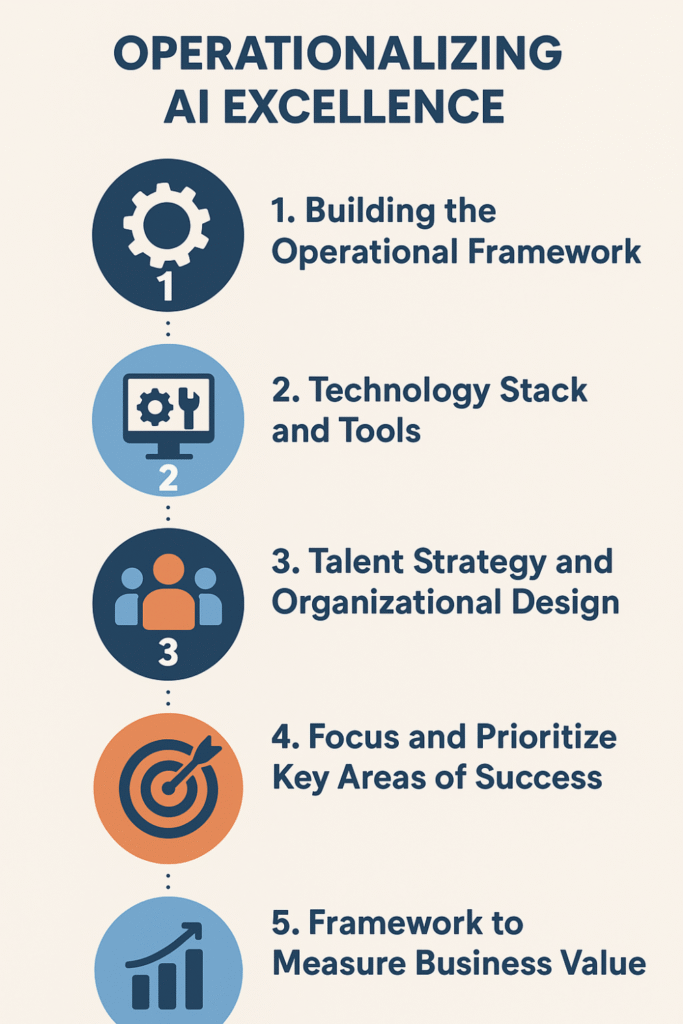
Building the Operational Framework

A well-defined operational framework provides structure and consistency to your AI initiatives, ensuring they are delivered efficiently, ethically, and in alignment with business objectives.

AI Project Lifecycle Management

Establishing a standardized methodology for the AI project lifecycle is crucial. This includes clearly defined phases for:

  • Discovery: Identifying business problems suitable for AI solutions and assessing their feasibility.
  • Development: Building, training, and validating AI models.
  • Deployment: Integrating models into production systems.
  • Monitoring: Continuously tracking model performance and identifying the need for retraining or adjustments.

Implementing quality gates and approval processes at each stage ensures rigor and accountability. Furthermore, risk management and compliance should be integrated throughout the lifecycle to proactively address potential issues related to data security, bias, and regulatory requirements.

Governance and Ethics

A strong ethical foundation is paramount for sustainable AI adoption. This necessitates developing a comprehensive AI ethics framework that outlines principles for responsible AI practices, such as fairness, transparency, and accountability.

Model governance and lifecycle management are critical for tracking model lineage, ensuring reproducibility, and managing model versions. Moreover, stringent adherence to data privacy and regulatory compliance, such as Singapore’s Personal Data Protection Act (PDPA), is non-negotiable.

Defining the Technology Stack and Tools

The right technology stack empowers your AI CoE to build, deploy, and manage AI solutions effectively.

Core Platform Components

Investing in robust platform components is essential:

  • MLOps and model management platforms: Streamlining the end-to-end machine learning lifecycle, including model training, deployment, monitoring, and governance.
  • Data infrastructure and pipeline tools: Providing scalable and reliable infrastructure for data storage, processing, and the creation of efficient data pipelines.
  • Development and collaboration environments: Facilitating seamless collaboration among team members with integrated development environments and version control systems.

Vendor vs. Build-or-Buy Decisions

Carefully evaluating whether to leverage off-the-shelf vendor solutions or build custom tools is crucial. Key evaluation criteria should include functionality, scalability, security, and ease of use. Integration with existing enterprise systems is a critical factor to avoid data silos and ensure seamless workflows. A thorough cost-benefit analysis framework should guide these decisions, considering both upfront investment and ongoing maintenance costs.

Create the Talent Strategy and Organizational Design

The success of your AI CoE hinges on attracting, developing, and retaining the right talent.

Core Roles and Responsibilities

Defining clear roles and responsibilities within the CoE is fundamental:

  • Data scientists and ML engineers: Responsible for developing, training, and deploying AI models.
  • AI solution architects and product managers: Defining the overall AI strategy and translating business needs into technical solutions.
  • Domain experts and business analysts: Providing crucial domain knowledge and ensuring AI solutions address real business problems.

Hiring and Development

Given the scarcity of AI talent, implementing effective recruitment strategies is vital. This includes actively engaging with the AI community and exploring diverse talent pools. Simultaneously, investing in upskilling existing workforce through training programs can bridge skill gaps. Creating clear career paths and retention strategies is essential to keep valuable AI professionals within your organization.

Organizational Design

The optimal organizational design for your AI CoE depends on your company’s structure and culture. Common models include:

  • Centralized: A single, dedicated AI team serving the entire organization.
  • Federated: AI teams embedded within different business units, with a central coordinating function.
  • Hybrid: A combination of centralized expertise and decentralized execution.

Regardless of the model, fostering cross-functional team formation ensures alignment between business needs and technical capabilities. Establishing clear performance management and incentives that recognize the unique contributions of AI roles is also important.

Focus and Prioritize Key Areas of Success

A strategic approach to identifying and prioritizing AI use cases is essential for maximizing impact.

Use Case Portfolio Management

Implementing a robust business impact assessment framework helps evaluate the potential value of different AI applications. This should be coupled with a technical feasibility analysis to assess the practicality of implementation. Based on these assessments, effective resource allocation strategies can be developed to focus on high-impact, feasible projects.

Domain-Specific Applications

AI can drive value across various business domains. Examples relevant to Singaporean businesses include:

  • Customer experience and personalization: Utilizing AI to understand customer preferences and deliver tailored experiences.
  • Operations and process optimization: Leveraging AI for automation, predictive maintenance, and supply chain optimization.
  • Risk management and compliance: Employing AI for fraud detection, regulatory reporting, and risk assessment.
  • Product and service innovation: Using AI to develop new AI-powered products and services.

Measuring ROI and Business Value

Demonstrating the tangible benefits of AI initiatives is crucial for securing continued investment and support.

Financial Metrics

Key financial metrics to track include:

  • Cost savings and efficiency gains: Quantifying reductions in operational costs and improvements in efficiency achieved through AI adoption.
  • Revenue generation and growth: Measuring the direct impact of AI-powered products and services on revenue.
  • Investment return calculations: Assessing the overall financial return on AI investments.

Operational Metrics

Beyond financial metrics, track operational performance:

  • Model performance and accuracy: Monitoring key metrics like precision, recall, and F1-score to ensure models are performing as expected.
  • Time-to-deployment improvements: Measuring the efficiency of the AI deployment process.
  • User adoption and satisfaction: Assessing how readily AI-powered tools and applications are being adopted and their impact on user satisfaction.

Strategic Metrics

Finally, consider strategic indicators of AI maturity:

  • Competitive advantage indicators: Evaluating how AI initiatives are contributing to a stronger market position.
  • Innovation pipeline health: Assessing the continuous flow of new AI ideas and projects.
  • Organizational AI maturity progression: Tracking the overall development and integration of AI capabilities within the organization.

By focusing on these key areas – building a strong operational framework, selecting the right technology and tools, cultivating a skilled talent pool, prioritizing impactful use cases, and rigorously measuring value – your AI Center of Excellence can effectively operationalize AI excellence and drive significant business outcomes.

This article is part of a 3-part series on a strategic roadmap to establish your AI Center of Excellence (CoE). You can read the first post here.
Filed Under: AI, Tech Tagged With: ai, machine learning, tech

Building Your AI Foundation: A Strategic Roadmap to Establishing an AI Center of Excellence (AI CoE)

August 18, 2025 by Ashwin Leave a Comment

In today’s business landscape, adopting AI is no longer a choice—it’s a competitive necessity. Many organizations are diving in, launching scattered projects across different departments. While this enthusiasm is commendable, these ad-hoc initiatives often lead to duplicated efforts, inconsistent standards, and a frustrating lack of tangible ROI. They create pockets of innovation that never scale into true transformation.

So, how do you move from random acts of AI to a powerful, integrated strategy?

The answer lies in establishing an AI Center of Excellence (CoE). A CoE is your organization’s central nervous system for all things AI—a dedicated team responsible for developing strategy, setting standards, and enabling the entire business to leverage AI effectively, ethically, and at scale. It’s the difference between building a collection of disjointed tools and creating a strategic capability.


Defining the AI Center of Excellence

An AI CoE is not just another IT or data analytics team. While traditional teams often focus on managing infrastructure or analyzing past data, the AI CoE is a forward-looking, strategic entity.

  • Core Mission: To accelerate the responsible adoption of AI to drive measurable business outcomes. This involves everything from identifying high-value use cases and developing solutions to promoting AI literacy and establishing ethical guardrails.
  • Key Differentiator: The CoE is fundamentally cross-functional. It doesn’t just build AI; it enables business units to leverage AI by providing expertise, best practices, and reusable tools. It’s a strategic partner, not just a service provider.
  • Success Factors: A successful CoE hinges on strong executive sponsorship, a clear charter and mandate, and deep alignment with business objectives. Without these, it risks becoming an isolated R&D lab with little real-world impact.

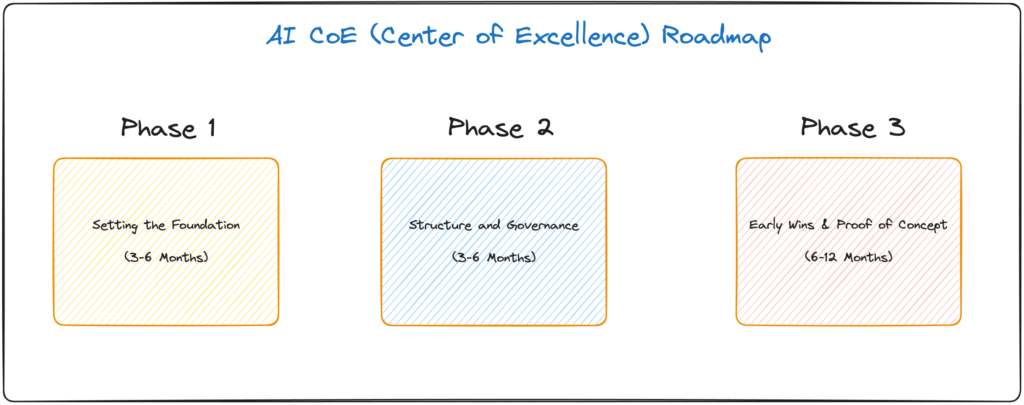
A Strategic Roadmap for Getting Started 🗺️

Launching a CoE is a journey, not a sprint. A phased approach ensures you build a solid foundation and demonstrate value along the way.

Phase 1: Foundation Setting (Months 1-3)

This initial phase is all about alignment and planning.

  • Secure Executive Sponsorship: Identify a champion in the C-suite who will advocate for the CoE and secure resources.
  • Assess AI Maturity: Honestly evaluate your organization’s current capabilities, data infrastructure, and talent. Where are you starting from?
  • Develop the Charter: Clearly define the CoE’s vision, mission, scope, and key performance indicators (KPIs). What does success look like in 12 months?

Phase 2: Structure and Governance (Months 3-6)

With a clear charter, you can now build the operational framework.

  • Define Reporting Structure: Decide where the CoE will sit organizationally to maximize its influence and cross-functional reach (e.g., reporting to the CTO, CDO, or even a Chief AI Officer).
  • Establish a Governance Framework: Create clear processes for project intake, prioritization, ethical review, and decision-making. Who gets to approve AI projects?
  • Plan Resources & Budget: Allocate a dedicated budget and outline a hiring plan for the core team.

Phase 3: Early Wins and Proof of Concept (Months 6-12)

Now it’s time to prove the model and build momentum. 🚀

  • Prioritize Use Cases: Develop a framework to identify projects with the highest potential ROI and strategic value.
  • Execute Pilot Projects: Select 1-2 high-impact pilot projects that can be delivered relatively quickly to demonstrate the CoE’s value.
  • Learn and Iterate: Treat these first projects as learning opportunities. Gather feedback, refine your processes, and celebrate successes to build support.

Overcoming Common Challenges

Every organization will face hurdles. Anticipating them is the first step to overcoming them.

  • Organizational Resistance: Change is hard. Overcome resistance by focusing on communication, education, and showcasing how the CoE empowers business units rather than controls them. Those early wins are your best marketing tool.
  • Budget Constraints & ROI: Frame the CoE as an investment, not a cost. Start with a lean team focused on high-ROI pilots to justify further investment.
  • The Skills Gap: Top AI talent is scarce. Address this with a dual approach: upskill your existing internal talent who have deep business knowledge and strategically hire external experts for specialized roles.

By taking a structured, strategic approach, you can build an AI CoE that not only avoids the pitfalls of ad-hoc experimentation but also becomes a powerful engine for sustainable growth and innovation.


What’s the biggest challenge your organization faces in scaling its AI initiatives? I’d love to hear your perspective in the comments.

Filed Under: AI, Tech Tagged With: ai, genai, machine learning, tech

Understanding the Paradigm of AI Tools, Apps and Agents

April 9, 2024 by Ashwin Leave a Comment

If you’ve been following the advancements in the AI (Artificial Intelligence) space, it will be no surprise to you that tons of models and apps are released every single day.

AI solutions come in various forms and solve a wide range of use cases. Though the evolution is still at its nascent stage, I see a few trends emerging.

In this post, I talk about three types or categories of AI solutions – AI tools, AI assistants, AI agents – why they exist and what problems they solve.


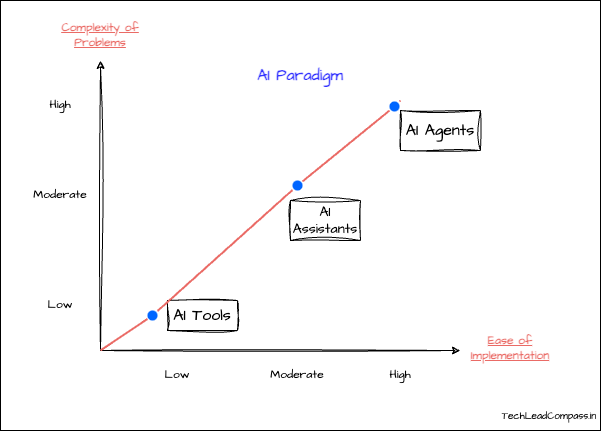
Here’s a comparison of the various types of AI solutions, their applicability, and ease of implementation.

AI Paradigm

Let’s start with the first one.

#1 AI Tools

This is something most of us are familiar with.

AI tools are software applications that using artificial intelligence and models, to perform specific tasks and solve problems.

ChatGPT, Copilot, and Perplexity are good examples of this.

What are their characteristics?

  • They offer a standard interface to interact (web app, mobile app, etc.)
  • They are useful for general-purpose use cases (e.g., summarizing an article, tightening a paragraph, understanding a specific topic, etc.)
  • With prompt engineering, they can understand your context and generate better content

They are good as a general-purpose vehicle, covering majority of an average person’s needs.

#2 AI Assistants

How do they differ from an AI tool? Not by a huge margin.

AI Assistants are a specific adaptation of AI tools that make it easier and simpler to use an application or a website

Have you seen the AI assistant in Notion, that helps you write? It is an AI assistant.

  • AI assistants are very context-specific and assist you with specific activities
  • They make use of one or more AI tools behind the scenes
  • With continuous usage, they can adapt and assist you better

#3 AI Agents

AI Agents take the game to the next level.

AI Agents are designed to perceive the environment, process signals, and take actions to achieve specific goals.

These agents can be software-based or physical entities and are commonly built using artificial intelligence techniques.

AI agents typically have 3 distinct components:

  • Sensors & Perception Layer – process signals and find out what’s happening in the environment
  • Skills Layer – to examine different options based on inputs
  • Decision Layer – to take actions and send it to the target environment

This space is still nascent. Auto-GPT, BabyAGI are some frameworks gaining traction.

There is consensus that most growth will be here – to automate workflows and perform actions that otherwise require complex decision-making.


To conclude…

AI Paradigm can be seen as a combination of general-purpose AI tools, specialized AI apps, and sophisticated AI agents. Each differs in its purpose, ease of use, and applicability. AI agents that mimic humans is where I anticipate huge growth in the future!

Filed Under: AI, Tech Tagged With: ai, genai, machine learning, ml, tech

  • « Go to Previous Page
  • Page 1
  • Page 2

Primary Sidebar

Connect with me on

  • GitHub
  • LinkedIn
  • Twitter

Recent Posts

  • Enterprise AI Agents: Why Governance is Your Competitive Advantage
  • How Do LLMs Work? A Simple Guide for Kids, Teens & Everyone!
  • Scaling AI Impact: Growing Your CoE and Charting the Future
  • Operationalizing AI Excellence: Processes, Tools, and Talent Strategy for AI CoE
  • Building Your AI Foundation: A Strategic Roadmap to Establishing an AI Center of Excellence (AI CoE)
  • Topics

    • Data & AI
      • AI Agents
    • Life
      • Leadership
      • Negotiations
      • Personal Finance
      • Productivity
      • Reading
      • Self Improvement
    • Post Series
      • Intro to Blockchain
    • Tech
      • AI
      • Blockchain
      • Career
      • Certifications
      • Cloud
      • Data
      • Enterprise
      • Generative AI
      • Leadership
      • Presentations
      • Reporting
      • Software Design
      • Stakeholders

Top Posts

  • Understanding the Paradigm of AI Tools, Apps and Agents
  • The Evolution of Data Platforms : Beyond Data Lakehouses
  • How hands-on an Engineering Leader should be?
  • How To Create Status Reports That Work?
  • Why and How to start with Mindful Meditation?

Copyright © 2025 · Ashwin Chandrasekaran · WordPress · Log in
All work on this website is licensed under a Creative Commons Attribution-ShareAlike 4.0 International License
The views and opinions expressed in this website are those of the author and do not necessarily reflect the views or positions of the organization he is employed with