• Skip to primary navigation
  • Skip to main content
  • Skip to primary sidebar

Meet Ashwin

Helping Engineers To Become Tech Leaders

  • Blog
  • Newsletter
  • Courses
    • Generative AI 101
    • LLMOps 101
    • Data Platforms Made Easy
  • Products
    • Generative AI Ecosystem Mindmap
    • 8 Mistakes to avoid in Tech Leadership (e-book)
  • Resources
  • Contact

Tech

Building Your AI Foundation: A Strategic Roadmap to Establishing an AI Center of Excellence (AI CoE)

August 18, 2025 by Ashwin Leave a Comment

In today’s business landscape, adopting AI is no longer a choice—it’s a competitive necessity. Many organizations are diving in, launching scattered projects across different departments. While this enthusiasm is commendable, these ad-hoc initiatives often lead to duplicated efforts, inconsistent standards, and a frustrating lack of tangible ROI. They create pockets of innovation that never scale into true transformation.

So, how do you move from random acts of AI to a powerful, integrated strategy?

The answer lies in establishing an AI Center of Excellence (CoE). A CoE is your organization’s central nervous system for all things AI—a dedicated team responsible for developing strategy, setting standards, and enabling the entire business to leverage AI effectively, ethically, and at scale. It’s the difference between building a collection of disjointed tools and creating a strategic capability.


Defining the AI Center of Excellence

An AI CoE is not just another IT or data analytics team. While traditional teams often focus on managing infrastructure or analyzing past data, the AI CoE is a forward-looking, strategic entity.

  • Core Mission: To accelerate the responsible adoption of AI to drive measurable business outcomes. This involves everything from identifying high-value use cases and developing solutions to promoting AI literacy and establishing ethical guardrails.
  • Key Differentiator: The CoE is fundamentally cross-functional. It doesn’t just build AI; it enables business units to leverage AI by providing expertise, best practices, and reusable tools. It’s a strategic partner, not just a service provider.
  • Success Factors: A successful CoE hinges on strong executive sponsorship, a clear charter and mandate, and deep alignment with business objectives. Without these, it risks becoming an isolated R&D lab with little real-world impact.

A Strategic Roadmap for Getting Started 🗺️

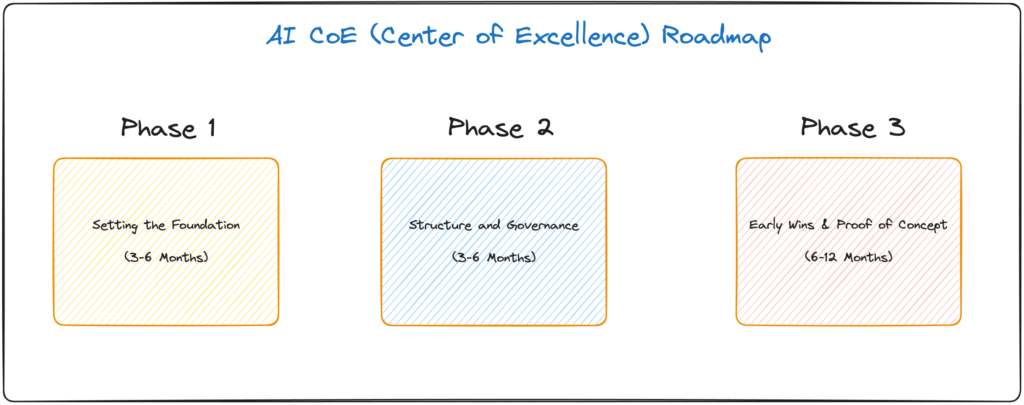
Launching a CoE is a journey, not a sprint. A phased approach ensures you build a solid foundation and demonstrate value along the way.

Phase 1: Foundation Setting (Months 1-3)

This initial phase is all about alignment and planning.

  • Secure Executive Sponsorship: Identify a champion in the C-suite who will advocate for the CoE and secure resources.
  • Assess AI Maturity: Honestly evaluate your organization’s current capabilities, data infrastructure, and talent. Where are you starting from?
  • Develop the Charter: Clearly define the CoE’s vision, mission, scope, and key performance indicators (KPIs). What does success look like in 12 months?

Phase 2: Structure and Governance (Months 3-6)

With a clear charter, you can now build the operational framework.

  • Define Reporting Structure: Decide where the CoE will sit organizationally to maximize its influence and cross-functional reach (e.g., reporting to the CTO, CDO, or even a Chief AI Officer).
  • Establish a Governance Framework: Create clear processes for project intake, prioritization, ethical review, and decision-making. Who gets to approve AI projects?
  • Plan Resources & Budget: Allocate a dedicated budget and outline a hiring plan for the core team.

Phase 3: Early Wins and Proof of Concept (Months 6-12)

Now it’s time to prove the model and build momentum. 🚀

  • Prioritize Use Cases: Develop a framework to identify projects with the highest potential ROI and strategic value.
  • Execute Pilot Projects: Select 1-2 high-impact pilot projects that can be delivered relatively quickly to demonstrate the CoE’s value.
  • Learn and Iterate: Treat these first projects as learning opportunities. Gather feedback, refine your processes, and celebrate successes to build support.

Overcoming Common Challenges

Every organization will face hurdles. Anticipating them is the first step to overcoming them.

  • Organizational Resistance: Change is hard. Overcome resistance by focusing on communication, education, and showcasing how the CoE empowers business units rather than controls them. Those early wins are your best marketing tool.
  • Budget Constraints & ROI: Frame the CoE as an investment, not a cost. Start with a lean team focused on high-ROI pilots to justify further investment.
  • The Skills Gap: Top AI talent is scarce. Address this with a dual approach: upskill your existing internal talent who have deep business knowledge and strategically hire external experts for specialized roles.

By taking a structured, strategic approach, you can build an AI CoE that not only avoids the pitfalls of ad-hoc experimentation but also becomes a powerful engine for sustainable growth and innovation.


What’s the biggest challenge your organization faces in scaling its AI initiatives? I’d love to hear your perspective in the comments.

Filed Under: AI, Tech Tagged With: ai, genai, machine learning, tech

The Evolution of Data Platforms : Beyond Data Lakehouses

April 7, 2025 by Ashwin Leave a Comment

The data platform landscape has undergone multiple transformations over the past decades – from traditional data warehouses to data lakes, and most recently to data lakehouses. Each evolution has addressed the limitations of previous architectures while accommodating new workloads and use cases. As we move into 2025, we’re witnessing the emergence of the next generation of data platforms designed specifically for the AI-driven world.

The Data Platform Journey

Early Days: Data Warehouses

Data warehouses revolutionized business intelligence by providing structured, optimized environments for SQL-based analytics on historical data. While powerful for reporting and dashboarding, they struggled with semi-structured data, real-time processing, and faced scalability challenges.

The Rise of Data Lakes

Data lakes emerged as cost-effective storage solutions that could handle massive volumes of raw, unprocessed data in various formats. They offered unprecedented flexibility but often became “data swamps” lacking governance, quality control, and performance optimization.

The Data Lakehouse Compromise

Data lakehouses represented a hybrid approach, combining the best of both worlds: the structure, transaction support, and performance of warehouses with the flexibility, scalability, and cost-effectiveness of data lakes. Solutions like Databricks’ Delta Lake, Snowflake, and Amazon Redshift Spectrum allowed organizations to manage both structured and unstructured data while supporting diverse workloads.

Beyond Data Lakehouses: The AI-Native Data Platform

As we move forward, data platforms are evolving once again to meet the demands of AI-driven workloads and applications. Here are the key characteristics defining this next generation:

1. Real-Time Intelligence Platforms

Tomorrow’s data platforms are moving beyond batch processing to enable true real-time intelligence:

  • Stream-first architecture: Processing data as it arrives rather than in batches
  • Event-driven processing: Triggering immediate actions based on data events
  • Continuous learning systems: Models that update themselves as new data arrives
  • Sub-second query performance: Providing immediate insights even on massive datasets

2. Semantic Layer Integration

Modern data platforms are incorporating semantic layers that abstract complexity and create business-meaningful representations:

  • Knowledge graphs: Representing relationships between entities in the data
  • Ontology management: Defining hierarchical relationships and taxonomies
  • Natural language interfaces: Allowing business users to query data conversationally
  • Metadata-driven automation: Using metadata to automate governance and processing

3. AI-Optimized Storage and Compute

The hardware and software stack is being reimagined specifically for AI workloads:

  • Vector databases: Specialized for embedding storage and similarity searches
  • GPU/TPU-native processing: Data engines optimized for tensor operations
  • Columnar-vector hybrid formats: Storage formats optimized for both analytics and ML
  • Compute-storage separation with smart caching: Enabling flexible scaling while maintaining performance

4. Intelligent Data Management

Data quality, governance, and management are becoming automated through AI:

  • Automated data quality: AI systems that detect and correct data quality issues
  • Self-healing pipelines: Workflows that can recover from failures autonomously
  • Predictive resource allocation: Intelligent scaling based on anticipated workloads
  • Continuous data observability: Real-time monitoring of data quality and lineage

5. Multi-Modal Data Processing

Next-generation platforms handle diverse data types natively:

  • Unified processing for structured, semi-structured, and unstructured data
  • Native support for text, images, audio, video, and time-series data
  • Integration with specialized AI models for each data type
  • Cross-modal analytics: Finding insights across different data modalities

The Impact on Organizations

This evolution is transforming how organizations operate:

1. Democratization of AI

  • Low-code/no-code ML platforms: Making AI accessible to business users
  • AutoML integration: Automated feature engineering, model selection, and tuning
  • Pre-built industry solutions: Domain-specific applications ready for deployment
  • AI assistants for data teams: Helping with everything from SQL generation to anomaly detection

2. Embedded Analytics and Operationalized AI

  • Decision intelligence platforms: Moving from descriptive to prescriptive analytics
  • Closed-loop systems: Taking automated actions based on AI predictions
  • AI-driven process optimization: Continuous improvement of business processes
  • Embedded ML in transactional systems: Making every application intelligent

3. Collaborative Data Ecosystems

  • Data mesh architectures: Domain-oriented, decentralized data ownership
  • Data sharing and marketplaces: Easier ways to exchange data internally and externally
  • Federated learning capabilities: Training models across distributed data sources
  • Cross-organizational AI collaboration: Shared models and insights across business boundaries

Challenges and Considerations

The path forward isn’t without obstacles:

1. Technical Challenges

  • Cost management: AI-optimized infrastructure can be expensive
  • Complex integration: Connecting legacy systems with new AI platforms
  • Performance tuning: Optimizing for diverse workloads simultaneously
  • Hybrid and multi-cloud management: Operating across diverse environments

2. Organizational Challenges

  • Skills gap: Finding talent familiar with cutting-edge AI data platforms
  • Change management: Shifting organizational processes to leverage AI capabilities
  • ROI measurement: Quantifying the business impact of AI investments
  • Risk management: Dealing with model drift, bias, and other AI-specific risks

3. Ethical and Compliance Considerations

  • Data privacy concerns: Managing sensitive data in AI systems
  • Transparency requirements: Explaining how AI systems make decisions
  • Regulatory compliance: Meeting evolving AI regulations
  • Sustainable computing: Addressing the environmental impact of data and AI workloads

Conclusion: The Intelligent Data Platform

The future beyond data lakehouses is the intelligent data platform – a comprehensive ecosystem that not only stores and processes data but actively helps organizations derive value from it through embedded AI capabilities.

These platforms will continue blurring the lines between data processing, analytics, and AI operations, creating integrated environments where data flows seamlessly from ingestion to insight to action.

For data leaders and organizations, the key to success will be selecting flexible, future-proof architectures that can evolve with the rapidly changing technology landscape while delivering immediate business value. The winners will be those who view data platforms not just as technical infrastructure but as strategic business assets enabling AI-driven transformation.

Filed Under: Data, Tech

Communicate your Software Design better with C4 Model

June 16, 2024 by Ashwin Leave a Comment

As engineers and tech leads, we often underestimate the need for our software design to be understandable.

The simpler the design, the higher its utility and purpose.

The C4 model is one of the popular and proven ways to visually communicate your design to a wide range of audiences. Its beauty is the “drill down” method, making it usable by technical and non-technical audiences.

What is a C4 Model in Software Design?

C4 models are a hierarchical abstraction of software systems, achieved through a set of diagrams. They are designed to be notation and tool-independent, which can be applied to almost all type of systems.

It is an “abstraction-first” model, that reflect how software architects and developers think about building software.

C4 stands for:

  • System Context
  • Container
  • Component
  • Code

In ascending order of granularity, each of these diagrams gives a more detailed view of the software system that’s being built.

What are the C4 Model Abstractions?

4 levels of abstraction are at the core of a C4 Model.

  1. Software system – the highest level of abstraction of any system that has some utility (e.g., a maps application)
  2. Containers – a software system is made up of one or more containers (e.g., applications, data stores, etc.)
  3. Component – each container is made up of several components (e.g., relational data store, NoSQL data store, etc.)
  4. Code – finally, each component is implemented by software code using a tech stack (e.g., MySQL, DynamoDB, etc.)

Each of these abstractions is represented as C4 diagrams.

C4 Model Diagrams

System Context Diagram

  • The system is visualized as a single box which is at the center
  • This diagram shows how the system interacts with its environment and users
  • Focus is on the people and interacting systems, not on technology or tools
  • Everyone, irrespective of their technical acumen, must be able to understand this diagram
System Context Diagram (https://c4model.com) for Software Design
System Context Diagram (https://c4model.com)

Container Diagram

  • A container view represents various applications that constitute the system
  • This diagram can show the major technology choices and how the containers interact with each other
  • It is intended for a technical audience, but anyone with a need to know how the system works can use this diagram
Container diagram (https://c4model.com) for Software Design
Container diagram (https://c4model.com)

Component diagram

  • In this diagram, the container is decomposed into structural building blocks and their interactions
  • Each component’s responsibilities, interaction with other components, and technical details are called out here
  • Software architects and developers are the primary intended audiences
  • It is not recommended for all teams, so use it only if you think it adds value
Component diagram (https://c4model.com) for Software Design
Component diagram (https://c4model.com)

Code diagram

  • Represents how each component is implemented as code – using UML diagrams, ER diagrams, etc.
  • Usually generated using IDE or UML modeling tools
  • This level of detail is normally required only for complex components
Code diagram (https://c4model.com) for Software Design
Code diagram (https://c4model.com)

In summary, C4 diagrams improve the communication efficiency of your software design. The level of detail and type of diagrams is contextual to the system under design.

Filed Under: Software Design, Tech Tagged With: architecture, c4model, software architecture, software design, tech, techleadership

  • « Go to Previous Page
  • Page 1
  • Page 2
  • Page 3
  • Page 4
  • Interim pages omitted …
  • Page 6
  • Go to Next Page »

Primary Sidebar

Connect with me on

  • GitHub
  • LinkedIn
  • Twitter

Recent Posts

  • How Do LLMs Work? A Simple Guide for Kids, Teens & Everyone!
  • Scaling AI Impact: Growing Your CoE and Charting the Future
  • Operationalizing AI Excellence: Processes, Tools, and Talent Strategy for AI CoE
  • Building Your AI Foundation: A Strategic Roadmap to Establishing an AI Center of Excellence (AI CoE)
  • The Evolution of Data Platforms : Beyond Data Lakehouses
  • Topics

    • Life
      • Leadership
      • Negotiations
      • Personal Finance
      • Productivity
      • Reading
      • Self Improvement
    • Post Series
      • Intro to Blockchain
    • Tech
      • AI
      • Blockchain
      • Career
      • Certifications
      • Cloud
      • Data
      • Enterprise
      • Generative AI
      • Leadership
      • Presentations
      • Reporting
      • Software Design
      • Stakeholders

Top Posts

  • Simple Productivity Hacks
  • What is Blockchain and Why do we need it?
  • A Framework to Acing Your Next Tech Presentation
  • Leading with Action
  • Create your first Application Load Balancer (ALB) in AWS

Copyright © 2025 · Ashwin Chandrasekaran · WordPress · Log in
All work on this website is licensed under a Creative Commons Attribution-ShareAlike 4.0 International License
The views and opinions expressed in this website are those of the author and do not necessarily reflect the views or positions of the organization he is employed with