• Skip to primary navigation
  • Skip to main content
  • Skip to primary sidebar

Meet Ashwin

Helping Engineers To Become Tech Leaders

  • Blog
  • Newsletter
  • Courses
    • Generative AI 101
    • LLMOps 101
    • Data Platforms Made Easy
  • Products
    • Generative AI Ecosystem Mindmap
    • 8 Mistakes to avoid in Tech Leadership (e-book)
  • Resources
  • Contact

Ashwin

Enterprise AI Agents: Why Governance is Your Competitive Advantage

December 13, 2025 by Ashwin Leave a Comment

Building AI agents in an enterprise extends far beyond prototypes and POCs. When designing agents for real users who drive revenue, governance becomes critical.

This post explores the essential governance pillars for integrating AI agents into enterprise production applications. 

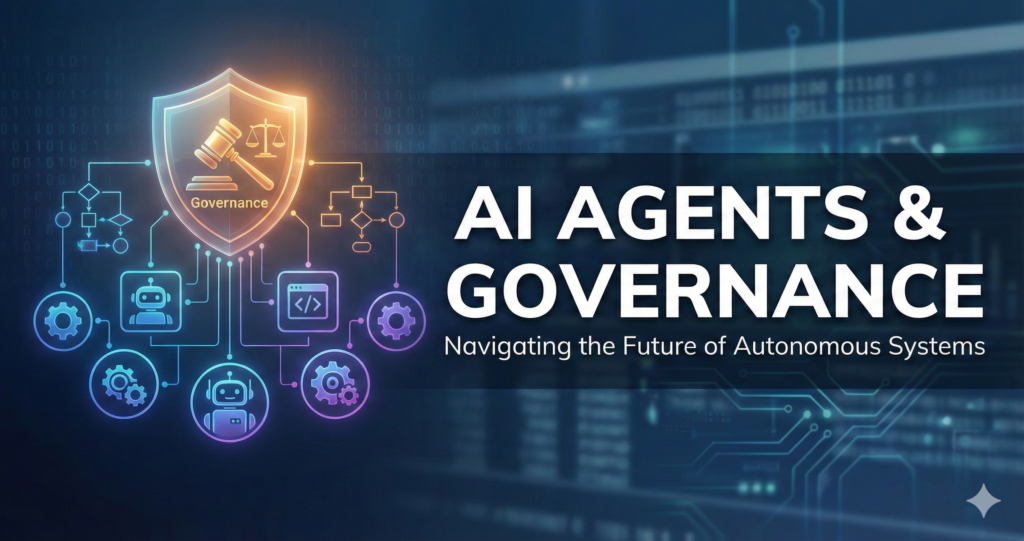
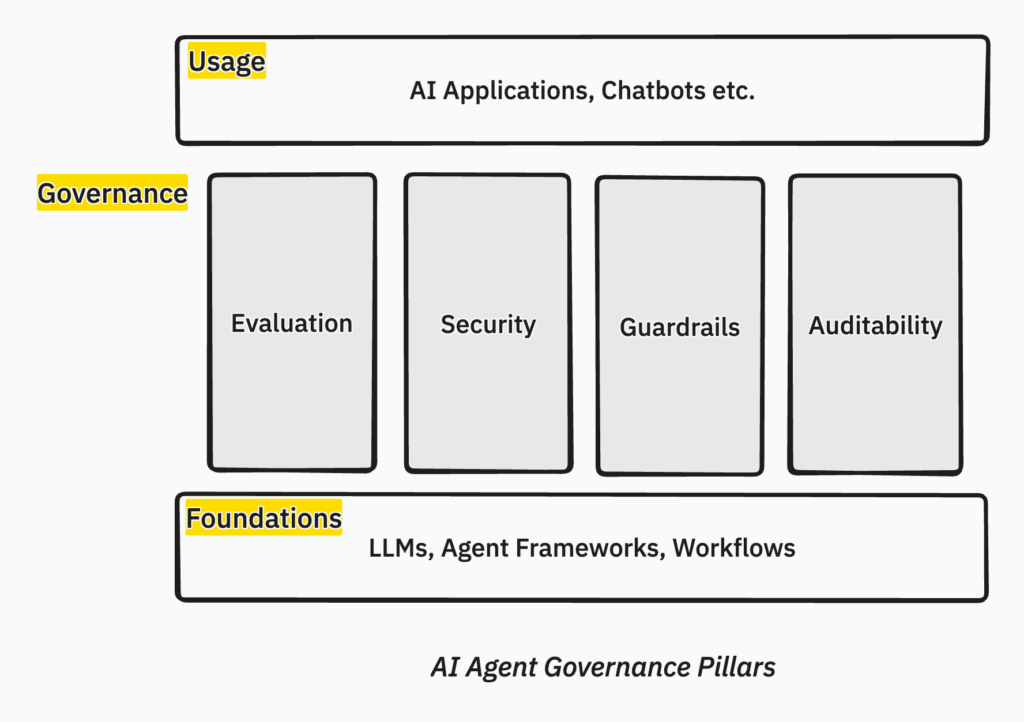
In the world of Agent Management Platforms, four governance pillars strengthen the successful rollout of AI agents in your organization.

Short on time? Check the TL;DR

Pillars of AI Agents Governance

AI Agents Governance Pillars
  • Evaluation – How do you evaluate the correctness and completeness of agent outputs
  • Security – How do you protect agents against malicious attacks and breaches
  • Guardrails – How do you set boundaries and checkpoints, often tied to your business and compliance rules
  • Auditability – How do you understand everything that has gone on before an agent produced the outputs

For this article, I will pick examples of each pillar from the open-source CrewAI Agentic framework.  But you can essentially implement it with other similar frameworks like LangGraph, Mastra, etc.


AI Agents Evaluation

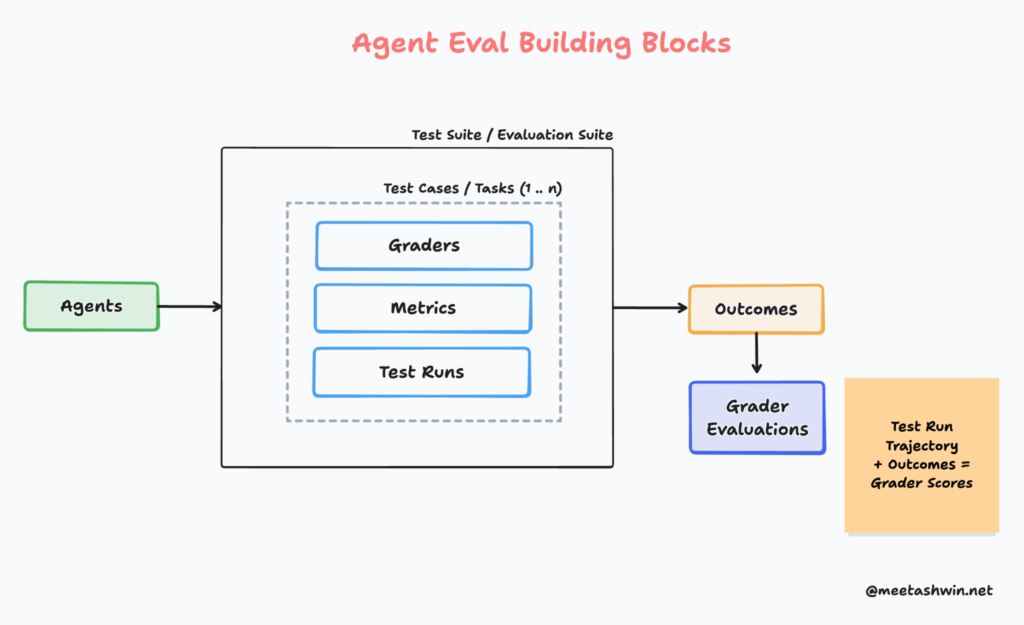
Evaluation in AI agent systems serves a similar purpose to testing in traditional software development—validating that the system performs as intended. 

However, AI agents built on large language models are non-deterministic systems. Unlike conventional software, where the same input consistently produces the same output, AI agents may generate different responses across multiple runs. This variability requires specialized evaluation approaches.

Understanding Non-Deterministic Behavior

The non-deterministic nature of LLM-based agents stems from temperature settings, sampling methods, and the probabilistic nature of language generation. 

While this enables creative problem-solving and natural interactions, it means traditional unit tests with exact output matching are insufficient. Instead, evaluation must assess whether outputs meet quality standards and functional requirements rather than matching predetermined values.

Two Complementary Evaluation Approaches

Effective AI agent evaluation employs two methodologies: subjective and objective evaluation.

Subjective Evaluation: LLM-as-Judge

Subjective evaluation leverages other LLMs to review, critique, and score agent outputs. This approach assesses qualities difficult to measure programmatically, such as relevance, coherence, helpfulness, and tone. 

An LLM judge evaluates whether an agent’s response appropriately addresses the user’s intent, maintains a consistent persona, or demonstrates sound reasoning.

The judge receives the original task, the agent’s output, and specific evaluation criteria. It then generates a critique and assigns scores, revealing subtle issues like logical inconsistencies or inappropriate confidence levels that traditional metrics might miss.

Objective Evaluation: Gold Standard Comparison

Objective evaluation relies on gold standard datasets—curated collections of inputs paired with known correct outputs. The process compares agent outputs against these benchmarks using quantifiable metrics such as accuracy, precision, recall, or task-specific success criteria.

For example, if an agent extracts structured information from documents, objective evaluation measures how accurately it identifies required fields compared to human-annotated examples. 

For multi-step workflows, evaluation verifies that the agent completes all necessary steps in the correct sequence.

Implementation in Practice

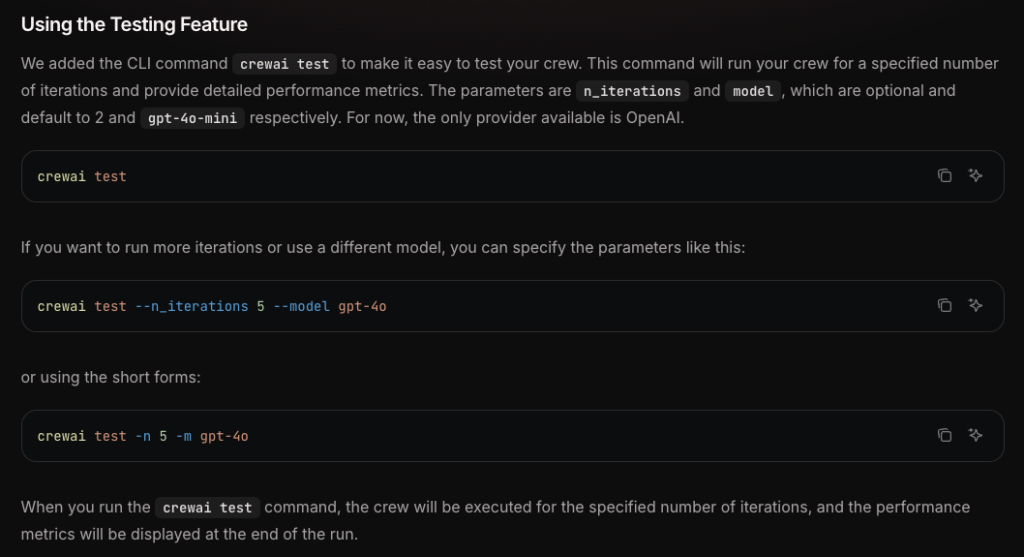
Modern agent frameworks like CrewAI provide built-in evaluation capabilities combining both approaches. 

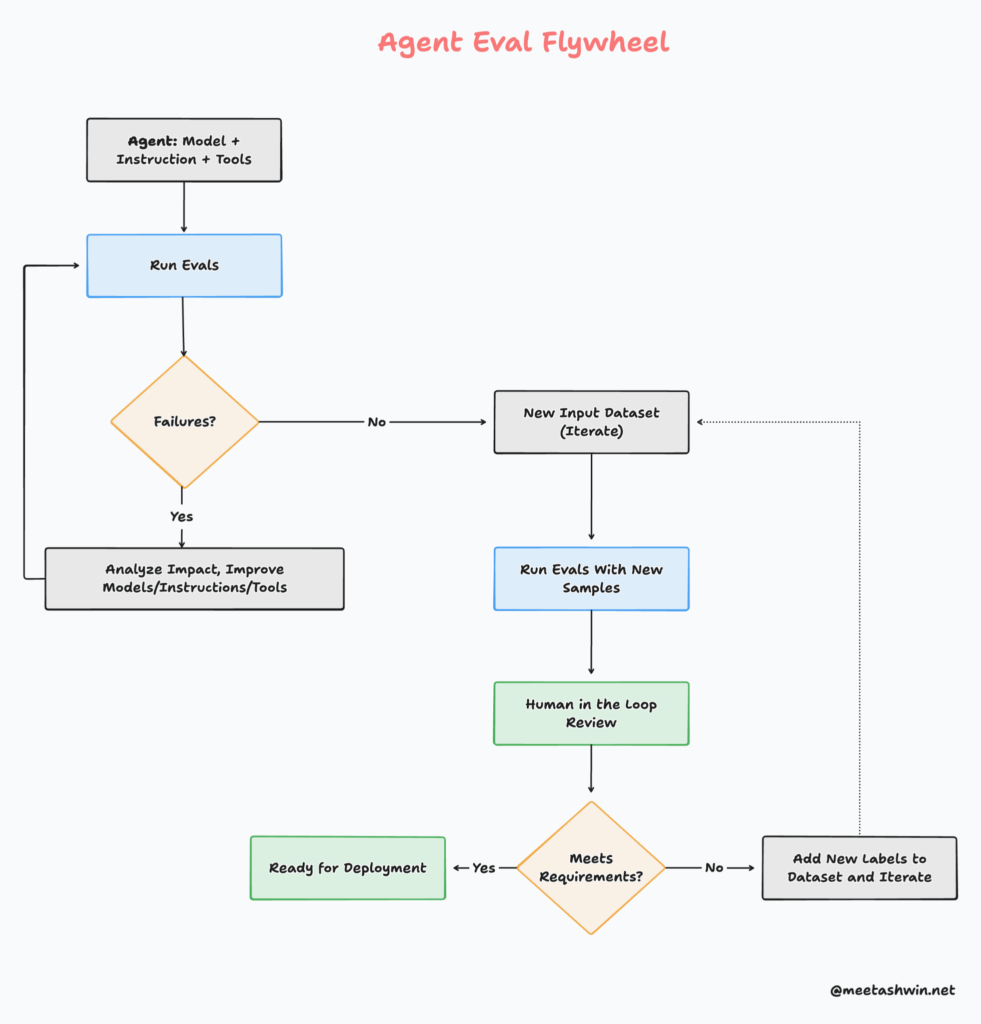
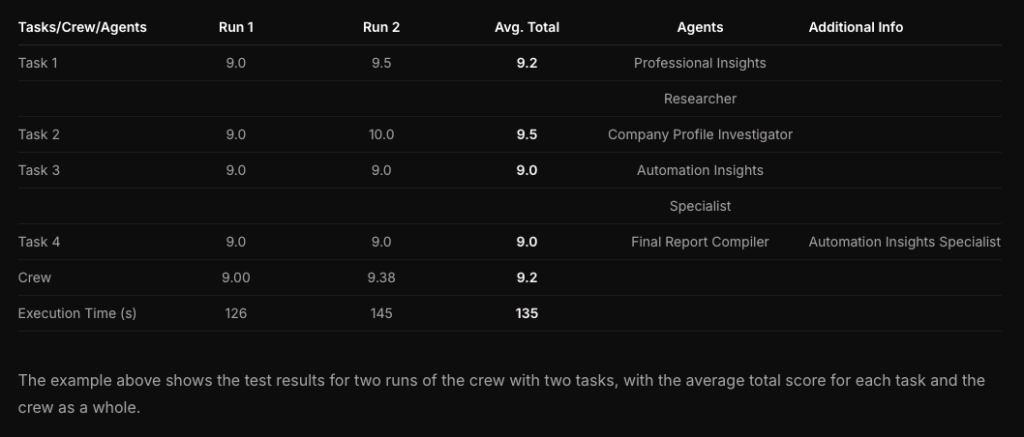
A typical workflow includes running the agent multiple times with the same test cases, applying LLM judges for subjective quality assessment, comparing outputs against gold standards, and aggregating results to identify patterns and issues.

Evaluation results inform iterative improvement. Teams can adjust agent instructions, refine prompts, modify tool configurations, or retrain components based on performance gaps. This continuous evaluation and refinement process is essential for maintaining reliable AI agent systems in production.


AI Agents Security

AI agents face unique security challenges that differ from traditional software vulnerabilities. As agents interact with users, access tools, and process data autonomously, they become targets for malicious attacks designed to manipulate their behavior or extract sensitive information.

Common Security Threats

Prompt Injection occurs when attackers craft inputs that override an agent’s original instructions, causing it to ignore safety guidelines or perform unintended actions. These attacks exploit the agent’s natural language interface to introduce malicious directives disguised as legitimate requests.

Tool Misuse happens when agents are manipulated into using their capabilities inappropriately—such as accessing unauthorized data, executing harmful commands, or making API calls that violate business rules. Since agents have direct access to tools and systems, compromised decision-making can have immediate consequences.

Data Poisoning involves corrupting the training data or knowledge bases that agents rely on, causing them to learn incorrect patterns or biased behaviors. Attackers may inject false information into retrieval systems or databases that agents query.

Context Poisoning targets the agent’s working memory by inserting misleading information into conversation history or retrieved documents. This can cause the agent to make decisions based on false premises or manipulated context.

Identity Spoofing exploits weak authentication mechanisms, allowing attackers to impersonate legitimate users or systems. Agents may then grant unauthorized access or perform actions on behalf of fake identities.

Security Countermeasures

Protecting AI agents requires multiple defensive layers. Input validation and sanitization filters suspicious patterns before they reach the agent’s core reasoning. Output monitoring detects when responses deviate from expected behavior or contain sensitive information leaks.

Tool access controls implement permission boundaries, ensuring agents can only invoke authorized functions with appropriate parameters. Context isolation separates user inputs from system instructions, making it harder for malicious prompts to override core directives.

Authentication and authorization frameworks verify user identities and enforce role-based access controls before agents process requests. Audit logging tracks all agent interactions, tool usage, and decision points for forensic analysis and compliance.

Adversarial testing proactively simulates attacks to identify vulnerabilities before deployment. Security-focused evaluation frameworks can test agent resilience against known attack patterns and edge cases.

Modern agent platforms are increasingly incorporating these security primitives as built-in features, but organizations must still configure them appropriately and maintain vigilance as new attack vectors emerge.


AI Agents Guardrails

AI agents operating autonomously in production environments require guardrails—protective boundaries that ensure safe, compliant, and aligned behavior. Unlike traditional software with hardcoded logic paths, agents make dynamic decisions that need real-time constraints to prevent harmful or inappropriate actions.

Types of Guardrails

Input Guardrails filter and validate incoming requests before they reach the agent’s reasoning engine. These prevent processing of prohibited content, malicious prompts, or queries outside the agent’s intended scope. Input guardrails can reject requests containing personal identifiable information (PII), offensive language, or topics the agent shouldn’t address.

Output Guardrails scan agent responses before delivery to users, blocking content that violates policies or quality standards. These catch hallucinations, inappropriate recommendations, leaked sensitive data, or responses that contradict business rules. Output guardrails ensure the agent doesn’t make unauthorized commitments or provide advice beyond its mandate.

Behavioral Guardrails constrain how agents use tools and make decisions during execution. These include spending limits on API calls, restrictions on which databases can be accessed, approval requirements for certain actions, and constraints on autonomous decision-making scope. For example, an agent might require human approval before financial transactions exceed a threshold.

Contextual Guardrails adapt constraints based on user roles, conversation context, or operational conditions. An agent might have different permissions for internal employees versus external customers, or operate under stricter rules during high-risk scenarios.

Implementation Approaches

Guardrails can be implemented through rule-based systems that enforce explicit policies, LLM-based classifiers that evaluate content against nuanced criteria, or hybrid approaches combining both. Modern agent frameworks provide guardrail APIs that intercept agent workflows at key checkpoints—before tool execution, after response generation, and during multi-step reasoning chains.

Effective guardrails balance safety with functionality. Overly restrictive guardrails frustrate users and limit agent utility, while insufficient guardrails expose organizations to risk. Continuous monitoring and adjustment ensure guardrails remain calibrated to organizational needs.


AI Agents Auditability

Auditability establishes transparency and accountability for AI agent operations. As agents make autonomous decisions that impact business outcomes, organizations need comprehensive records of what agents did, why they did it, and what information influenced their decisions.

Essential Audit Components

ComponentWhyWhat to capture?

Decision Trails
Understand why an agent reached a particular conclusion or took a specific action.Capture the agent’s reasoning process, including which tools were invoked, what information was retrieved, how the agent weighted different factors, and what alternatives were considered.

Interaction Logs
To understand the complete context of each interaction, supporting compliance reviews, quality assurance, and issue resolutionAll user inputs, agent outputs, and conversation flows.Logs should include timestamps, user identifiers, session metadata, and any relevant business context.

Tool Usage Records
For security monitoring, cost management, and understanding the agent’s operational footprint across enterprise systems.Document every external system call, API request, database query, and file access performed by the agent.

Performance Metrics
Identify patterns that indicate degraded performance, emerging issues, or opportunities for improvement.Track success rates, response times, error frequencies, and user satisfaction scores.

Compliance and Governance

Auditability supports regulatory compliance by providing evidence of proper agent behavior. Industries with strict oversight—such as finance, healthcare, and legal services—require detailed records demonstrating that agents operated within approved parameters and didn’t make unauthorized decisions.

Audit data also enables retrospective analysis when issues arise. If an agent provides incorrect information or makes a problematic decision, audit trails allow teams to reconstruct the event, identify root causes, and implement corrective measures.

Implementation Considerations

Effective audit systems must balance comprehensiveness with storage and privacy concerns. Logs should capture sufficient detail for meaningful analysis while protecting sensitive information. Retention policies should align with regulatory requirements and business needs.

Modern agent platforms provide structured logging frameworks that automatically capture key events in standardized formats. Organizations should integrate these logs with existing observability and compliance systems, enabling centralized monitoring and analysis across all AI agent deployments.


Conclusion

AI agents represent a fundamental shift in how enterprises deliver value—moving from deterministic software to autonomous systems that reason, decide, and act on behalf of organizations. This power comes with responsibility. Without robust governance, agents can make costly mistakes, expose sensitive data, violate policies, or erode user trust.

The four governance pillars—evaluation, security, guardrails, and auditability—form an integrated framework for deploying AI agents safely and effectively in production environments.

Evaluation ensures agents perform reliably despite their non-deterministic nature, combining subjective LLM-based assessment with objective benchmarking to validate quality before and after deployment.

Security protects against emerging threats unique to AI systems, from prompt injection to identity spoofing, implementing defensive layers that safeguard both the agent and the systems it accesses.

Guardrails establish boundaries that keep agents aligned with organizational policies and ethical standards, constraining behavior without sacrificing the flexibility that makes agents valuable.

Auditability provides transparency into agent operations, creating decision trails that support compliance, enable root cause analysis, and build stakeholder confidence in autonomous systems.

Together, these pillars transform AI agents from experimental prototypes into trustworthy enterprise tools. Organizations that invest in governance upfront accelerate adoption, reduce risk, and unlock the full potential of AI agents to drive business value. As agents become more capable and autonomous, governance won’t be optional—it will be the foundation of successful AI implementation.

Filed Under: AI, AI Agents, Data & AI, Tech Tagged With: agent governance, agents, ai, ai agents, aiagents, data

How Do LLMs Work? A Simple Guide for Kids, Teens & Everyone!

November 30, 2025 by Ashwin Leave a Comment

How LLM Works

Have you ever wondered how ChatGPT or other AI chatbots can write stories, answer questions, and have conversations with you? Let me explain it in a way that’s easy to understand!

The Magic Black Box

Imagine a large language model (LLM) as a mysterious black box. You type something into it (like a question or a story prompt), and it gives you text back as an answer. Simple, right? But what’s happening inside?

Before we peek inside, here’s something important: this black box has been “trained” by reading millions and millions of books, websites, and articles. Think of it like a student who has read every book in the world’s biggest library! All that reading becomes the LLM’s vocabulary and reference material.

Now, let’s open up that black box and see what’s really going on inside.

Inside the Black Box: Three Important Parts

When we look inside, we actually find three smaller boxes working together:

  1. The Encoder – The Translator
  2. The Attention Mechanism – The Detective
  3. The Decoder – The Writer

Let’s explore each one!

Part 1: The Encoder (The Translator)

The Encoder’s job is to translate your words into a language that computers understand: numbers!

Step 1: Making Tokens – First, your sentence gets broken into pieces called “tokens.” These are like puzzle pieces made of words or parts of words. Each token gets assigned a number. For example:

  • “apple” might become token #5234
  • “car” might become token #891

Step 2: Creating a Meaning Map – But here’s where it gets cool! The Encoder doesn’t just turn words into random numbers. It places them on a special map called a “vector embedding.” This map shows how words relate to each other based on their meaning.

Imagine a huge playground where similar words stand close to each other:

  • The word “apple” would stand near “fruit,” “orange,” and “banana”
  • It would also stand somewhat near “computer” (because of Apple computers)
  • But it would be really far away from “car” or “rocket”

This map helps the LLM understand that words can have similar meanings or be used in similar ways.

Part 2: The Attention Mechanism (The Detective)

This is where the real magic happens! The Attention Mechanism is like a detective trying to figure out what you really mean.

Understanding Context Let’s say you type: “The bat flew out of the cave.”

The word “bat” could mean:

  • A flying animal, OR
  • A baseball bat

The Attention Mechanism’s job is to figure out which meaning you’re talking about by looking at the other words around it. When it sees “flew” and “cave,” it realizes you’re probably talking about the animal!

How Does It Do This?

The Attention Mechanism uses something called Multi-Head Attention. Instead of looking at one word at a time, it looks at groups of words together to understand the full picture.

Think of it like this: If you’re trying to understand a painting, you don’t just look at one tiny spot. You step back and look at different parts of it from different angles. That’s what multi-head attention does with your sentence!

The Scoring Game: Q-K-V

Here’s how the detective assigns importance scores to words:

  1. Query (Q): “What am I looking for?” – This is your input word asking a question
  2. Key (K): “What do I know?” – This is the relevant information from the LLM’s huge knowledge base
  3. Value (V): “How important is this?” – This is the score that tells the LLM which words matter most

For our bat example, the word “flew” would get a high score because it’s super important for understanding that we’re talking about the animal, not the baseball bat!

The Feed-Forward Network

After scoring all the words, something called a Feed-Forward Neural Network (FFN) steps in. Think of it as a teacher organizing messy notes into a clean outline. It takes all those scores and organizes them neatly.

This whole process—the scoring and organizing—repeats several times to make sure the LLM really, really understands what you’re asking. Each time through, the understanding gets sharper and clearer.

Part 3: The Decoder (The Writer)

Now that the LLM understands what you’re asking, it’s time to create an answer! That’s the Decoder’s job.

Finding the Best Word

The Decoder looks at all the attention scores and context, then asks: “What’s the best word to say next?”

It searches through its vocabulary and calculates probabilities. For example, if you asked “What color is the sky?” the Decoder might find:

  • “blue” has a 70% probability
  • “gray” has a 15% probability
  • “pizza” has a 0.001% probability (doesn’t make sense!)

The Decoder picks the word with the highest probability—in this case, “blue.”

Building Sentences Word by Word

Here’s something cool: the LLM doesn’t write the whole answer at once. It writes one word at a time, super fast!

After it writes “blue,” it asks again: “What should the next word be?” Maybe it adds “and” or “on” or “during.” Each word it picks becomes part of the context for choosing the next word.

This keeps going—pick a word, add it to the response, pick the next word—until the full answer is complete.

Back to Human Language

Remember how we turned your words into numbers at the beginning? Well, the Decoder does the opposite at the end! It takes all those number tokens and converts them back into words you can read.

And voila! You get your answer!

Putting It All Together

Let’s see the whole process with an example:

You type: “What do cats like to eat?”

  1. Encoder: Converts your question into tokens and places them on the meaning map. It knows “cats” are near “pets” and “animals,” and “eat” is near “food” and “hungry.”
  2. Attention Mechanism: The detective analyzes the question and realizes the important words are “cats” and “eat.” It assigns high scores to these words and understands you’re asking about cat food.
  3. Decoder: Looks at the context and starts writing: “Cats” (highest probability first word) → “like” (next best word) → “to” → “eat” → “fish,” → “chicken,” → “and” → “cat” → “food.”

Each word gets converted back from numbers to text, and you see the complete answer appear on your screen!

The Speed of Thought

All of this—the encoding, the attention detective work, the decoding—happens in just seconds or even split seconds! The LLM processes your input through these three stages so quickly that it feels like magic.

But now you know the secret: it’s not magic. It’s a clever system of translating, understanding context, and finding the most likely words to respond with, all powered by the massive amount of reading the LLM did during its training.

Remember the Key Ideas

  • LLMs are like super-readers who’ve read millions of books and can use that knowledge to chat with you
  • The Encoder turns your words into numbers and maps their meanings
  • The Attention Mechanism is a detective figuring out what you really mean
  • The Decoder picks the best words one by one to answer you
  • Everything happens lightning-fast, even though there are many steps!

Now you know how an LLM works! Pretty cool, right? Next time you chat with an AI, you’ll know exactly what’s happening behind the scenes.

Filed Under: AI, Generative AI, Tech Tagged With: 101, ai, data, genai, llm, llmfundamentals, tech

Scaling AI Impact: Growing Your CoE and Charting the Future

September 1, 2025 by Ashwin Leave a Comment

This article is part of a 3-part series on a strategic roadmap to establish your AI Center of Excellence (CoE). You can read the first and second posts here.


The journey of an AI Center of Excellence (CoE) typically begins with promising pilots and initial successes. Yet, the true measure of an AI CoE’s impact lies not just in these early wins, but in its ability to scale those successes across the organization, transforming isolated projects into pervasive, enterprise-wide capabilities. This isn’t merely about doing more AI; it’s about doing AI better, more efficiently, and with greater strategic alignment.

This article, the third in our series, delves into how an AI CoE can move beyond initial triumphs to achieve broad-based impact. We’ll start by exploring the critical steps involved in Expanding Scope and Scale, transforming successful proofs-of-concept into industrial-grade solutions and broadening AI’s reach across the enterprise.

From Pilots to Production at Scale: Industrializing AI

Many organizations find themselves stuck in “pilot purgatory” – an abundance of promising AI prototypes that never quite make it to full-scale production. Overcoming this is arguably the most significant challenge in scaling AI impact. It requires a fundamental shift in mindset and methodology, moving from agile experimentation to robust industrialization.

Industrializing Successful Proof of Concepts

The transition from a successful proof-of-concept (PoC) to a production-ready solution is fraught with challenges. A PoC is designed to validate an idea; a production system must be reliable, scalable, secure, and maintainable. This shift requires a rigorous process of industrialization.

  • Robust Engineering Principles: This means applying software engineering best practices to AI development. Version control isn’t just for code; it’s for data, models, and configurations. Automated testing should cover data quality, model performance, and integration points. Code reviews and documentation become non-negotiable.
  • Performance and Scalability: A PoC might work with a small dataset on a single machine. Production demands handling massive data volumes, processing requests with low latency, and scaling dynamically with demand. This often involves re-architecting solutions to leverage distributed computing, cloud-native services, and optimized model serving infrastructure.
  • Security and Compliance: Production AI systems must adhere to the organization’s security protocols and relevant regulatory compliance standards (e.g., GDPR, HIPAA, PDPA in Singapore). This includes secure data handling, model access control, audit trails, and vulnerability management.
  • Maintainability and Observability: Production systems need to be easily monitored, debugged, and updated. This involves instrumenting models and pipelines with logging, metrics, and alerts. A clear incident response plan for model degradation or failure is crucial.

Building Repeatable Deployment Frameworks

To move beyond one-off deployments, CoEs must develop repeatable deployment frameworks. This is where MLOps (Machine Learning Operations) truly shines, providing the backbone for industrializing AI.

  • Standardized CI/CD Pipelines for ML: Just as DevOps revolutionized software delivery, MLOps streamlines the continuous integration, continuous delivery, and continuous deployment of machine learning models. This means automating the process from model training and validation to deployment and monitoring.
  • Containerization and Orchestration: Using technologies like Docker for containerizing models and their dependencies, combined with Kubernetes for orchestration, enables consistent deployment across different environments (development, staging, production) and efficient scaling.
  • Model Registries and Versioning: A centralized model registry serves as a single source of truth for all trained models, their versions, metadata, and performance metrics. This allows for easy tracking, comparison, and rollback if needed.
  • Automated Monitoring and Alerting: Deploying a model is not the end; it’s the beginning of its lifecycle. Automated monitoring systems should track model performance (accuracy, latency, drift), data quality, and infrastructure health. Alerts should be triggered when performance degrades or anomalies are detected, prompting re-training or intervention.

Managing Increased Complexity and Volume

As the number of AI applications grows, so does the operational complexity. A CoE must evolve its strategies to manage this increased volume.

  • Centralized Management Plane: A unified dashboard or platform to oversee all deployed models, their status, performance, and resource consumption becomes essential. This provides a holistic view and facilitates proactive management.
  • Resource Allocation and Cost Optimization: Scaling AI means consuming more computational resources. The CoE needs robust processes for allocating GPU time, cloud compute, and storage, along with strategies for cost optimization (e.g., leveraging spot instances, right-sizing resources).
  • Knowledge Management and Documentation: As more models are deployed, comprehensive documentation for each – detailing its purpose, data sources, training methodology, performance characteristics, and known limitations – becomes critical for future maintenance, auditing, and knowledge transfer.
  • Dedicated Operations Teams: For larger CoEs, a dedicated MLOps or AI Operations team may be necessary. This team focuses specifically on the reliability, scalability, and performance of production AI systems, allowing data scientists and ML engineers to concentrate on model development.

Broadening Domain Coverage: Extending AI’s Reach

Once the CoE demonstrates its ability to reliably industrialize AI solutions, the next natural step is to broaden its impact by extending AI’s application into new business areas. This involves strategic expansion, fostering collaboration, and driving enterprise-wide standardization.

Expanding into New Business Areas

Initial AI successes often cluster around specific pain points or enthusiastic business units. Scaling impact means intentionally seeking out and penetrating new domains.

  • Strategic Opportunity Mapping: Proactively identify business units or functions that could benefit significantly from AI, even if they haven’t explicitly requested it. This requires deep business understanding and a consultative approach.
  • Value-Driven Prioritization: Continue to prioritize new use cases based on clear business value (e.g., revenue generation, cost reduction, risk mitigation) and technical feasibility, using a consistent framework across the organization.
  • Building Trust and Advocacy: Each successful project in a new domain builds trust and creates internal advocates for AI. These advocates become crucial in driving further adoption.

Cross-Functional Collaboration Models

As AI expands, the CoE cannot operate in a vacuum. Effective cross-functional collaboration becomes paramount.

  • Embedded Teams or Liaisons: Consider embedding data scientists or AI solution architects within key business units for a period. This fosters deeper domain understanding and strengthens relationships. Alternatively, appoint AI liaisons from the CoE to specific business units to act as conduits for requirements and insights.
  • Shared Objectives and KPIs: Align AI project objectives and key performance indicators (KPIs) with the strategic goals of the collaborating business units. This ensures that AI initiatives are directly contributing to shared success.
  • Joint Steering Committees: Establish steering committees with representatives from the CoE and key business stakeholders to oversee the AI roadmap, resolve bottlenecks, and ensure strategic alignment.
  • Federated Models of Execution: As the organization matures, a “federated” AI model might emerge, where individual business units develop their own AI capabilities while the central CoE provides governance, shared platforms, and expertise. This requires clear interfaces and communication channels.

Enterprise-Wide AI Standardization

To avoid fragmentation and technical debt as AI proliferates, the CoE must drive enterprise-wide standardization.

  • Common Tooling and Platforms: While flexibility is good, too many disparate tools can hinder collaboration and increase operational overhead. The CoE should define recommended or mandatory tools for data science, MLOps, and deployment.
  • Best Practices and Guidelines: Publish clear guidelines for data governance, model development, responsible AI practices, and security. This ensures consistency and quality across all AI initiatives, regardless of where they originate.
  • Shared Data Assets: Work with data governance teams to establish shared, high-quality data assets that can be leveraged by multiple AI projects across different domains. This avoids redundant data preparation efforts and ensures data consistency.
  • Knowledge Sharing Platforms: Implement internal wikis, forums, or regular “AI show-and-tell” sessions to facilitate knowledge sharing, disseminate best practices, and foster a sense of community among AI practitioners across the organization.

This concludes the 3-part series on strategizing, implementing and scaling AI CoE (Center of Excellence) in your organization. It is a long and arduous journey, and these posts will give a head start to a tech leader like you!

In case you missed the other posts, you can read them here – first and second post.

Filed Under: AI, Tech Tagged With: ai, ai coe, machine learning, tech

  • Page 1
  • Page 2
  • Page 3
  • Interim pages omitted …
  • Page 12
  • Go to Next Page »

Primary Sidebar

Connect with me on

  • GitHub
  • LinkedIn
  • Twitter

Recent Posts

  • Enterprise AI Agents: Why Governance is Your Competitive Advantage
  • How Do LLMs Work? A Simple Guide for Kids, Teens & Everyone!
  • Scaling AI Impact: Growing Your CoE and Charting the Future
  • Operationalizing AI Excellence: Processes, Tools, and Talent Strategy for AI CoE
  • Building Your AI Foundation: A Strategic Roadmap to Establishing an AI Center of Excellence (AI CoE)
  • Topics

    • Data & AI
      • AI Agents
    • Life
      • Leadership
      • Negotiations
      • Personal Finance
      • Productivity
      • Reading
      • Self Improvement
    • Post Series
      • Intro to Blockchain
    • Tech
      • AI
      • Blockchain
      • Career
      • Certifications
      • Cloud
      • Data
      • Enterprise
      • Generative AI
      • Leadership
      • Presentations
      • Reporting
      • Software Design
      • Stakeholders

Top Posts

  • Understand your Stakeholders with a Stakeholder Map
  • A Framework to Acing Your Next Tech Presentation
  • Create your first Application Load Balancer (ALB) in AWS
  • Enterprise AI Agents: Why Governance is Your Competitive Advantage
  • What is Blockchain and Why do we need it?

Copyright © 2025 · Ashwin Chandrasekaran · WordPress · Log in
All work on this website is licensed under a Creative Commons Attribution-ShareAlike 4.0 International License
The views and opinions expressed in this website are those of the author and do not necessarily reflect the views or positions of the organization he is employed with